
Biology Test
Revise the topics, then attempt the timed test.
Topics to revise
- Cells and cell organelles
- Human body systems and organs
- Blood, vitamins and hormones
- Plants and photosynthesis
- Common diseases and genetics
Practice tests

Biology Test 01
25 timed Biology MCQs for Army, Navy and PAF initial tests, with answers and explanations.
Start Test
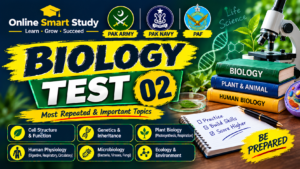
Biology Test 02
25 timed Biology MCQs on the human body, plants, blood, vitamins and genetics for Army, Navy and PAF tests, with explanations.
Start TestPrefer untimed practice? Open Biology MCQs. See also the Academic Tests page.
How to Score Well in the Biology Timed Test
Biology carries a good share of marks in many initial tests, and most of the questions come from familiar school chapters. A timed test helps you find out how well you remember names, functions and processes when the clock is running. Attempt it after revising the topics listed above, and use your score as a guide to what needs more attention in the coming days.
Understand before you memorise
Biology looks like a subject of names, but it becomes easier when you understand how parts work together. Learn what the heart, lungs and kidneys do, and how food, air and blood move through the body. Link each organelle in a cell with its job. When you understand the function, the name is easier to remember, and a differently worded question does not confuse you.
Use tables and diagrams
Visual memory is powerful in biology. Draw the heart, a plant cell and the digestive system on rough paper and label them from memory. Make a table of vitamins with their sources and deficiency diseases, and another for blood groups and common infections. Look at your drawings and tables for a few minutes every day. Over time they will appear in your mind during the test.
Collect the easy marks first
In a timed test, answer the questions you know at once and mark the doubtful ones. Biology often has many direct questions that take only a few seconds, so collecting them early gives you more time for harder ones. Read the whole question before the options, and watch words such as largest, smallest, first and main, because they change the correct answer completely.
Learn from the result
Once the test ends, review every wrong answer and write the correct fact beside it. Notice whether the mistakes are in one topic, such as genetics or plants, or spread across many. Revise the weakest area first and retake the test after a week. A steady cycle of attempt, review and retest improves recall far more than reading the book again from the beginning.
Revise in layers
Revise new facts after one day, after three days and after one week. Use spare moments, such as a bus ride or a short break, to recall a topic mentally. Before sleeping, read your notes once more, because short revision at night stays in memory longer. This layered method is simple, takes little time and keeps biology fresh until the day of the test.
For untimed practice with explanations, open Biology MCQs. You can also try the other academic tests, read the study plan guide and visit the MCQ categories. Test patterns differ between courses, so confirm the real format from official sources.
 HUB
 TEST
 MCQs
 HUB
 HUB
 HUB