
Academic Tests
Free Mock Test of each subject.
Academic subjects
Academic papers usually check school-level knowledge. Revise the basics first, then practice under a timer. Each subject page below has a topic guide and a timed test.
Academic test subjects
English Test
Grammar, vocabulary, spelling and sentence correction.
Start test →Mathematics Test
Percentages, algebra, ratio, geometry and averages.
Start test →Physics Test
Units, motion, force, electricity and light.
Start test →Chemistry Test
Elements, symbols, acids, bases and reactions.
Start test →Biology Test
Cells, human body, plants and genetics.
Start test →General Knowledge Test
Pakistan studies and general awareness.
Start test →How to Prepare for Academic Tests
Academic tests check the school-level knowledge that every candidate is expected to carry into the selection process. The subjects usually include English, mathematics, physics, chemistry, biology and general knowledge, although the exact mix depends on the course you choose. Because the questions come from familiar textbooks, the best strategy is not to study more, but to study smarter, with a clear plan, regular revision and honest timed practice.
Find your strong and weak subjects
List all subjects and mark each one as strong, average or weak. Spend your first week revising weak subjects, because these hold the largest chance of improvement. Do not ignore strong subjects, though. A short daily revision keeps them sharp and protects easy marks. This simple, honest list prevents you from wasting hours on topics that you already know well.
Use topic guides, then timed tests
Each subject page on this website begins with a short list of topics to revise, followed by a timed test. Read the topics first, study the material from your own books and then attempt the test without help. Afterwards, compare your answers with the explanations and mark the topics where you lost marks. This cycle of revise, test and review is the fastest way to improve.
Make revision stick
Memory fades quickly when facts are only read once. Revise new material after one day, after three days and after one week. Write formulas, definitions and dates on small cards and carry them with you. Teach a topic aloud to a friend or even to yourself, because explaining something shows exactly where your understanding is weak. These small habits make a big difference in long-term memory.
Manage time in the test
Speed matters because academic papers contain many questions in limited time. Answer the easy questions first, mark the doubtful ones and return to them at the end. Check the official instructions about negative marking before deciding whether to guess. Practise under a timer so that the real test feels familiar rather than stressful.
Balance study with rest
A tired mind learns slowly. Sleep seven to eight hours, take short breaks between sessions and spend a little time outdoors each day. Candidates who rest properly usually remember more and make fewer careless mistakes than those who study all night. Plan one lighter day every week so that you return to your books with fresh energy and a clear head.
Also Visit
- 200 Repeated Verbal MCQs With Answers
- 100 Repeated English MCQs With Answers
- 100 Repeated Chemistry MCQs With Answers
- Chemistry Test 02
- General Knowledge Test 01
- General knowledge Test 02
- 100 Repeated Biology MCQs With Answers
- Intelligence Mock tests
- Verbal Intelligence Test
- English Mock tests
- Math Mock tests
- General knowledge Mock tests
- Chemistry Mock tests
- Free Biology MCQs
- Free Chemistry MCQs
- Free Physics MCQs
- View all MCQs
- View All Latest Posts
- Calculate Your BMI
 HUB
 HUB
 HUB
 HUB
 HUB
 HUB
 HUB
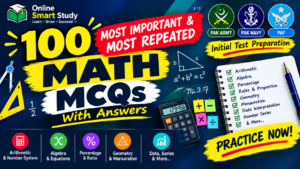 MCQs