
English Test
Revise the topics, then attempt the timed test.
Topics to revise
- Parts of speech and tenses
- Subject-verb agreement and articles
- Prepositions and common idioms
- Synonyms, antonyms and spelling
- Active, passive and indirect speech
Practice tests

English Test 01
25 timed English MCQs on grammar, vocabulary, idioms and spelling, with answers and explanations.
Start Test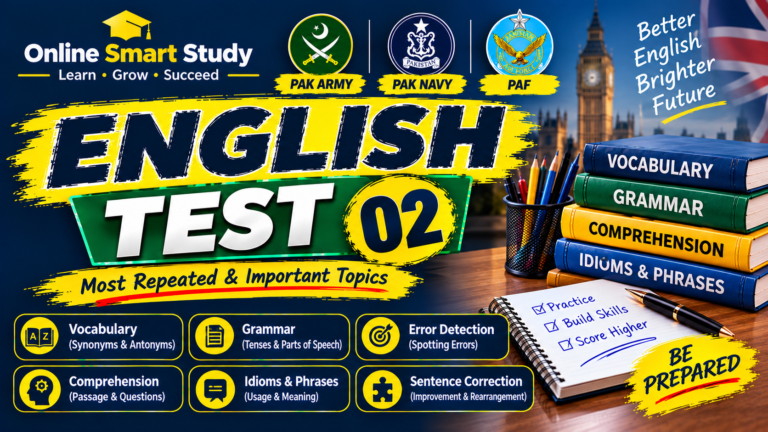
English Test 02
25 timed English MCQs on grammar, vocabulary, prepositions, idioms, voice and speech for Army, Navy and PAF tests, with explanations.
Start TestPrefer untimed practice? Open English MCQs. See also the Academic Tests page.
How to Score Well in the English Timed Test
The English timed test is a quick way to measure how ready you are for the language section of armed forces initial tests. Unlike untimed practice, a timed test shows how you behave when the clock is running, which is exactly the situation you will face on the real day. Attempt it only after you have revised the topics listed above, so that the result tells you something useful about your preparation.
Prepare before you press start
Spend a few days revising before every attempt. Review parts of speech, tenses and subject-verb agreement, then move to articles, prepositions and common idioms. Learn a few new words each day with their synonyms and antonyms, and check the spelling of words that are often confused. Sit in a quiet place, keep rough paper nearby and silence your phone, so that the score reflects your real level.
Manage your time sensibly
English questions are usually short, so they should not take long. Aim to answer each question in under a minute and mark any doubtful one for later. Read the full sentence before checking options, because the clue is often at the end. Vocabulary questions need instant recall, so do not waste time overthinking them. If you cannot recall a word, eliminate the options that clearly do not fit and choose the best remaining one.
Review your result properly
The score is only the beginning. After the test, go through every wrong answer and write down the rule or the word you missed. Group your mistakes into categories such as tenses, prepositions, vocabulary and spelling. The category with the most mistakes tells you where to spend your next study week. Retake the test after a week and compare the two scores to see whether your revision is working.
Common mistakes to avoid
Many candidates choose an answer because it sounds familiar rather than because it is correct. Others confuse similar words or forget basic rules under pressure. Avoid changing an answer without a strong reason, and read passive and indirect speech questions twice. Build accuracy through regular revision of grammar rules and vocabulary lists instead of last-minute cramming.
Build a weekly routine
Plan three short English sessions a week: one for grammar, one for vocabulary and one for a full timed attempt. Keep each session under forty minutes so your mind stays fresh. Read a short English article on the other days and underline new words. This light routine, repeated for a month, builds steady improvement without exhausting you.
For untimed practice with explanations, open English MCQs. You can also try the other academic tests, read the study plan guide and visit the MCQ categories. Test patterns differ between courses, so confirm the real format from official sources.
 HUB
 TEST
 MCQs
 HUB
 HUB
 HUB