
Mathematics Test
Revise the topics, then attempt the timed test.
Topics to revise
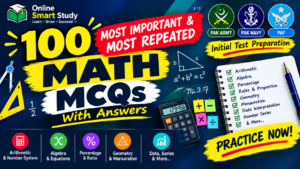
- Percentages, ratio and average
- Profit, loss and simple interest
- Speed, time, distance and work
- Algebra and simple equations
- LCM, HCF, geometry and mensuration
Practice tests

Mathematics Test 01
25 timed Mathematics MCQs on percentages, ratio, algebra and geometry, with answers and explanations.
Start Test
Mathematics Test 02
25 timed Mathematics MCQs on percentages, algebra, fractions, geometry and probability for Army, Navy and PAF tests, with explanations.
Start TestPrefer untimed practice? Open Mathematics MCQs. See also the Academic Tests page.
How to Score Well in the Mathematics Timed Test
Mathematics is the subject where preparation shows most clearly in the final result, and a timed test is the best way to check your readiness. The questions usually stay at school level, but the clock makes them feel harder than they are. Use this test to measure both your accuracy and your speed, and attempt it after you have revised the topics listed above, so that the score gives you honest feedback.
Revise methods, not just answers
Before the test, solve a few questions from every topic on paper. Revise the method for percentages, ratio, average, profit and loss, simple interest, speed and distance, and work and time. Learn tables and squares up to twenty so that calculation does not slow you down. Knowing the method means that a new question of a familiar type takes only seconds, even if the numbers are different.
Use time wisely
Decide your time per question before you start. If the test has twenty-five questions, the clock tells you roughly how long each one can take. Solve the easy questions first and mark the long ones for later. When a calculation looks heavy, try estimating or putting the options back into the question. Never let one stubborn problem take the time of three easier ones.
Check your work smartly
Careless mistakes cost as many marks as weak concepts. Always check the unit and ask whether the question wants a total, a part or a difference. Re-read the final line of the problem before choosing an option. If time remains at the end, re-solve two or three questions that you answered quickly. A short check at the end often saves marks that would otherwise be lost.
Learn from every attempt
After the test, list every wrong or guessed question and write the correct method beside it. Notice whether the mistake came from a weak concept, a calculation slip or a lack of time. Solve similar questions again after three days. Take the test again after a week and compare your scores. Improvement may feel slow at first, but it becomes clear within a few weeks of steady practice.
Build a simple routine
Plan a short mathematics session every day instead of a long one on weekends. Spend ten minutes on mental calculation, twenty minutes on topic questions and one full timed attempt every week. Keep a notebook of formulas and mistakes. This steady routine builds both speed and confidence, which are the two things that matter most in a timed paper.
For untimed practice with explanations, open Mathematics MCQs. You can also try the other academic tests, read the study plan guide and visit the MCQ categories. Test patterns differ between courses, so confirm the real format from official sources.
 HUB
 TEST
 MCQs
 HUB
 HUB
 HUB