
Physics Test
Revise the topics, then attempt the timed test.
Topics to revise
- Units and measurements
- Motion, force and Newton's laws
- Work, energy and power
- Light, sound and waves
- Electricity and heat
Practice tests
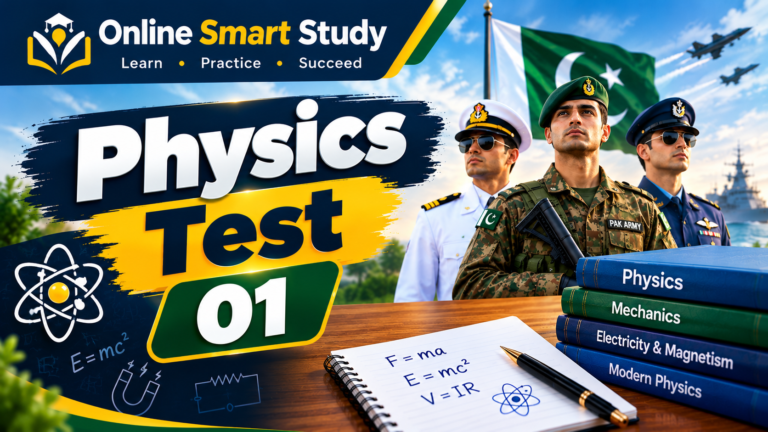
Physics Test 01
25 timed Physics MCQs on units, motion, energy, electricity and light, with answers and explanations.
Start Test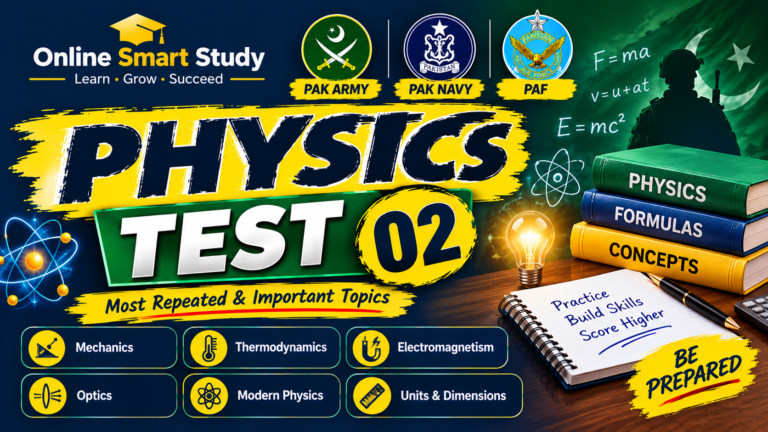
Physics Test 02
25 timed Physics MCQs on units, electricity, motion, light, heat and waves for Army, Navy and PAF tests, with explanations.
Start TestPrefer untimed practice? Open Physics MCQs. See also the Academic Tests page.
How to Score Well in the Physics Timed Test
Physics questions in initial tests are usually direct and based on school-level chapters, which makes a timed test a very useful checkpoint. It shows whether you remember definitions, units and simple formulas well enough to answer quickly. Attempt it after you have revised the topics listed above, and treat the result as feedback about your preparation, not as a judgement about your ability.
Learn units and definitions first
Many physics questions can be answered if you know the correct unit or definition. Make a one-page chart of the SI units for force, work, energy, power, pressure, charge and current, and revise it daily. Learn the difference between pairs such as speed and velocity, or mass and weight. These small facts appear again and again, and they are the quickest marks you can collect in the paper.
Practise formulas through problems
Reading a formula is not the same as using it. Solve at least one numerical question from motion, work and energy, electricity and heat every day. Write the formula, substitute the values with their units and check that the final unit matches the quantity asked. This habit prevents silly mistakes and makes the formulas stick in memory far better than simple repetition.
Keep an eye on the clock
Aim to finish theory questions in less than half a minute and spend the saved time on numerical ones. If a problem looks long, break it into two small steps and solve them one by one. Mark any question that takes more than a minute and return to it at the end. A calm, steady speed always beats a rushed start followed by panic.
Review and repeat
After the test, look at every mistake and ask what caused it: a forgotten unit, a wrong formula or a misread question. Write the correction in your notebook and revise those pages every evening for a week. Then retake the test and compare your scores. This simple loop of attempting, reviewing and repeating is what slowly turns physics from a worry into a strength.
Connect physics with daily life
Try to connect topics with everyday things. Notice how a fan uses electricity, how a lever makes work easier or why a ball slows down. When you can explain an idea with an everyday example, you understand it well enough to answer a question about it in any form. This habit also makes revision more interesting and much less tiring.
For untimed practice with explanations, open Physics MCQs. You can also try the other academic tests, read the study plan guide and visit the MCQ categories. Test patterns differ between courses, so confirm the real format from official sources.
 HUB
 TEST
 MCQs
 HUB
 HUB
 HUB