
Chemistry Test
Revise the topics, then attempt the timed test.
Topics to revise
- Atoms, elements and the periodic table
- Symbols and chemical formulas
- Acids, bases and pH
- Chemical bonding
- Everyday chemistry and common gases
Practice tests

Chemistry Test 01
25 timed Chemistry MCQs on symbols, formulas, acids, bases and atoms, with answers and explanations.
Start Test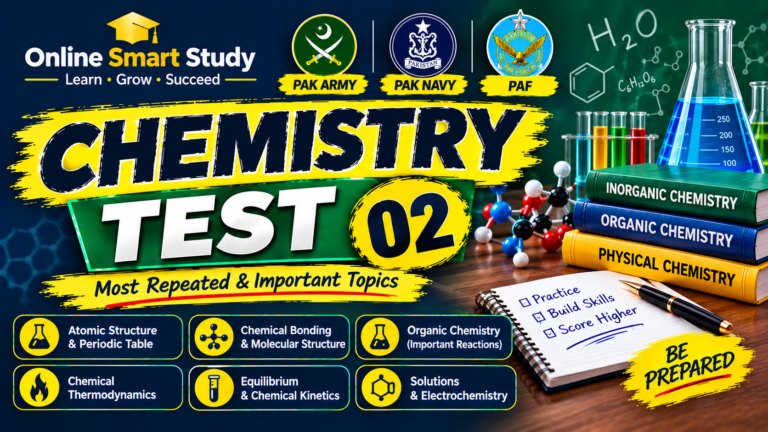
Chemistry Test 02
25 timed Chemistry MCQs on symbols, formulas, atomic structure, gases and chemical changes for Army, Navy and PAF tests, with explanations.
Start TestPrefer untimed practice? Open Chemistry MCQs. See also the Academic Tests page.
How to Score Well in the Chemistry Timed Test
Chemistry rewards candidates who remember facts clearly and read questions carefully. The timed test lets you check both skills together, because the clock reveals how quickly you can recall symbols, formulas and basic ideas. Take it after revising the topics listed above, and use the result to decide which areas need another round of attention before the real selection test.
Start with the periodic table
The periodic table is the base of almost every chemistry question at school level. Learn the first twenty elements with their symbols and atomic numbers, then add common metals and non-metals. Understand groups, periods and valency in simple words. Revise a few elements every day instead of the whole table at once. Daily repetition makes these facts automatic, which saves precious seconds during the timed test.
Remember acids, bases and common compounds
Make a small table of common acids, bases and salts with their formulas and uses. Learn the pH scale and which household substances are acidic or basic. Revise gases such as oxygen, carbon dioxide, nitrogen and hydrogen, along with their simple properties. Tables help because chemistry is full of names, and a table lets your eyes find the pattern much faster than a long paragraph.
Avoid confusing look-alikes
Many marks are lost because of similar-looking symbols and names. Na and N, Ca and C, or sulphate and sulphite can easily be mixed up under pressure. Write such pairs on a card and revise them often. During the test, read each option slowly, cross out the clearly wrong ones and then decide. A few extra seconds of care can save you from an avoidable mistake.
Review your mistakes honestly
After the test, check each wrong answer and write the correct fact in your notebook. Divide mistakes into groups such as symbols, compounds, acids and bases, and reactions. The largest group shows what to revise next. Retake the test after a week and compare your results. Steady review of this kind will improve your accuracy more than reading a whole chapter again and again.
Short sessions work best
Chemistry facts stay in memory when they are revised in short bursts. Study for twenty-five minutes, take a five-minute break and then quickly recall what you learned without looking at your notes. Revise the same facts the next day and again after three days. This spaced method may feel slow, but it moves information into long-term memory far better than a single long night of study.
For untimed practice with explanations, open Chemistry MCQs. You can also try the other academic tests, read the study plan guide and visit the MCQ categories. Test patterns differ between courses, so confirm the real format from official sources.
 HUB
 TEST
 MCQs
 HUB
 HUB
 HUB